Skip to content




If you’ve watched your portfolio climb over the past year, you’re not imagining it. The S&P 500 has set more than 20 record highs in 2026 and is up roughly 10% year-to-date, driven by strong corporate earnings and a powerful run in technology stocks. For investors who stayed the course, the paper gains have been substantial.
But here’s the question every seasoned investor eventually has to ask: a gain isn’t real until you protect it. When markets are this high, and valuations are stretched to levels rarely seen in the index’s nearly 70-year history, the smartest move isn’t always to keep riding the wave. It’s to take some of what you’ve earned off the table and move it into something built to hold its value when the cycle turns.
For a growing number of investors approaching retirement, that “something” is gold.
Why Now Is the Moment to Think About Locking In Gains
There’s an old discipline among experienced investors: sell into strength, not weakness. The time to reposition a portfolio is when assets are richly valued, and confidence is high, not after a correction has already erased your gains.
Right now, several signals are worth paying attention to:
- Record highs and rich valuations. The S&P 500 recently closed above 7,600 for the first time. By some measures, the index is trading at a valuation it has reached only once before in its history. Elevated valuations don’t guarantee a downturn, but they do mean there’s less margin for error.
- Concentration risk. Much of the 2026 rally has been powered by a handful of large technology names. When gains are concentrated, so is the risk. A pullback in a few stocks can drag the whole index down.
- A long bull run eventually turns. A long bull run eventually turns. Markets move in cycles, and this one has been running for years. No expansion lasts forever, and the longer a rally climbs without a meaningful pause, the more it pays to have a plan for the other side of it. Locking in gains now is far easier than trying to win them back after a correction.
None of this means abandoning the stock market. It means being intentional about protecting the gains you’ve already captured. Converting a portion of your stock market profits into gold is one of the most time-tested ways to do exactly that.
Ready to Learn More?
Schedule a complimentary strategy call with one of our specialists today.
No pressure, no sales-y jargon, just clear and honest guidance to help you invest with confidence.
INVESTMENTS
SECURE


Why Gold, and Why It Pairs So Well With Stocks
Gold isn’t meant to replace your equities. It’s meant to balance them. The reason it works so well as a counterweight comes down to one word: correlation.
Historically, gold has had low, and at times negative, correlation with the stock market. When stocks struggle, gold has often held steady or risen, helping offset losses elsewhere in your portfolio. That’s the entire point of diversification: owning assets that don’t all move in the same direction at the same time.
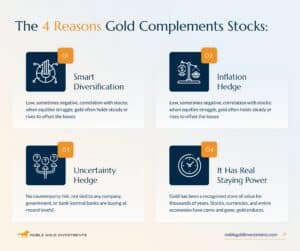
A few of the qualities that make gold a natural complement to stock gains:
It’s a powerful diversifier. Because gold tends to move independently of stocks, adding it spreads your risk across assets that don’t rise and fall together. When one part of your portfolio is down, another may be holding firm, smoothing out the ride over time.
It’s a hedge against inflation. Gold has historically held its purchasing power when the value of the dollar erodes. As paper currency buys less, hard assets like gold have tended to hold, or grow, their real value.
It’s a hedge against uncertainty. Central banks have been buying gold at record levels, and persistent global uncertainty continues to drive demand for hard assets. Gold has no counterparty risk. It isn’t dependent on a company’s earnings, a government’s promise, or a bank’s solvency.
It has real staying power. Gold has been a recognized store of value for thousands of years. Stocks, currencies, and entire economies have come and gone; gold endures.
To put the protective value in perspective: on a $1 million retirement portfolio, an allocation of around 10% to gold would have reduced losses during the worst year of the 2008 financial crisis by more than $17,000. That’s the kind of cushion that helps you sleep at night when headlines turn ugly.
The Smart Way to Transfer Stock Gains Into Gold: A Gold IRA
Here’s where many investors leave money on the table. If you sell appreciated stocks in a regular brokerage account to buy gold, you may trigger capital gains taxes on those profits. But there’s a more tax-efficient path: a Gold IRA.
A Gold IRA is a self-directed individual retirement account that allows you to hold physical, IRS-approved precious metals instead of just paper assets. It gives you the same tax advantages as a conventional IRA, with the diversification benefits of owning real gold.
How the Tax Advantages Work
- Traditional Gold IRA: Your gold grows tax-deferred. You don’t pay taxes on gains year to year. Taxes are deferred until you take withdrawals in retirement, potentially at a lower tax bracket.
- Roth Gold IRA: Qualified withdrawals in retirement can be completely tax-free, meaning any appreciation in your gold could potentially avoid capital gains taxes altogether.
Transferring Funds Without Triggering Taxes
If your stock gains are already in a retirement account such as a 401(k), 403(b), or traditional IRA, you can often move them into a Gold IRA through a direct rollover without triggering taxes or penalties, as long as it’s structured correctly. A direct, custodian-to-custodian rollover is generally preferred precisely because it avoids those complications.
This is the key insight: you can reposition retirement assets you’ve grown in the stock market into gold without taking a tax hit in the process. Your gains stay invested and protected, just in a more resilient form.
What to Know Before You Start
A few practical details worth understanding up front:
- 2026 contribution limits: $7,500 per year, or $8,600 if you’re 50 or older, useful if you want to add new money on top of a rollover.
- Purity and storage rules: IRS-approved gold must meet minimum purity standards (99.5% for bullion) and be held by a qualified custodian in an approved depository, not at home.
- Fees: Annual costs covering the custodian, storage, and setup typically run a few hundred dollars per year. Noble Gold’s fees are listed here.
New to precious metal investing? Download our Gold and Silver investing guide for the most important information to help you get started.
Ready to Learn More?
Schedule a complimentary strategy call with one of our specialists today.
No pressure, no sales-y jargon, just clear and honest guidance to help you invest with confidence.
INVESTMENTS
SECURE
A Simple Framework for Repositioning Your Gains
If the idea of converting stock gains into gold resonates, here’s a clear way to think about it:
- Decide on an allocation. Many investors near retirement target 5% to 10% of their portfolio in precious metals. Choose a figure that matches your comfort with risk and your timeline.
- Identify the source. Are you rolling over funds from an old 401(k) or IRA, or contributing new money? A rollover from an existing retirement account is often the most tax-efficient route.
- Open a self-directed Gold IRA. This is the account that lets you hold physical metals with full IRA tax benefits.
- Fund it and select your metals. Work with a specialist to complete a direct rollover and choose IRS-approved gold (and, if you wish, silver, platinum, or palladium).
- Store it securely. Your metals are held in an approved depository, fully insured and accounted for in your name.
The entire process can typically be completed in a matter of days, not weeks, and you don’t have to navigate the IRS rules alone.
Protect the Gains You Worked Hard to Earn
The stock market has been good to disciplined investors. But bull markets don’t last forever, and the investors who keep their wealth are the ones who protect their gains before the cycle turns, not after. Moving a portion of your stock market profits into physical gold is a proven way to add stability, hedge against inflation and uncertainty, and safeguard the retirement you’ve spent decades building.
At Noble Gold Investments, we specialize in helping investors do exactly this: converting hard-won stock gains into the lasting security of physical gold, with a straightforward rollover process and no-pressure guidance every step of the way.
Ready to protect what you’ve earned? Open a Gold IRA with Noble Gold Investments today and turn your stock market gains into something that lasts. Speak with one of our precious metals specialists to see how quickly and easily you can reposition a portion of your portfolio into gold.
Ready to Learn More?
Schedule a complimentary strategy call with one of our specialists today.
No pressure, no sales-y jargon, just clear and honest guidance to help you invest with confidence.
INVESTMENTS
SECURE
Frequently Asked Questions
Can I Move my Stock Gains into Gold Without Paying Taxes? If your gains are held in a retirement account like a 401(k) or traditional IRA, you can typically move them into a Gold IRA through a direct rollover without triggering taxes or penalties, provided it’s structured correctly. Selling appreciated stocks in a taxable brokerage account, by contrast, may create a capital gains tax liability.
How Much of my Portfolio Should I Invest in Gold? Many financial professionals suggest an allocation of 5% to 10% for diversification and protection. The right amount depends on your risk tolerance, timeline to retirement, and overall financial picture.
Is Now a Good Time to Buy Gold if it’s Pulled Back From its Highs? Gold eased from its early-2026 peak of roughly $5,400 to the $4,100 to $4,200 range by late June. Many investors view pullbacks as an opportunity to add a long-term protective asset at a lower entry point, though no one can predict short-term price movements. Gold’s role is long-term stability, not short-term timing.
What’s the Difference Between a Gold IRA and just Buying Gold? A Gold IRA holds physical, IRS-approved gold inside a tax-advantaged retirement account, offering tax-deferred or tax-free growth. Buying gold in a regular account doesn’t carry those tax benefits, and selling stocks to fund it may create a taxable event.
Where is the Gold in my IRA Stored? IRS rules require Gold IRA metals to be held by a qualified custodian in an approved, insured depository, not at your home. Noble Gold Investments handles secure storage as part of the process.