Skip to content



Deciding to add gold or silver to a portfolio is only half the decision. The other half is how to hold it: buy it outright with cash, or fund a self-directed Gold IRA or Silver IRA using retirement funds. Both paths lead to owning real, physical metal backed by the same purity standards and the same underlying value. They just get there through very different tax treatment, storage rules, and levels of access.
Neither option is inherently better than the other. The right choice depends on what you’re funding the purchase with, how soon you might need access to it, and how much weight you put on tax deferral versus flexibility. This guide walks through each factor so you can make that call with a clear picture of the trade-offs, and shows how Noble Gold Investments supports either path with the same transparency and buyback protection.
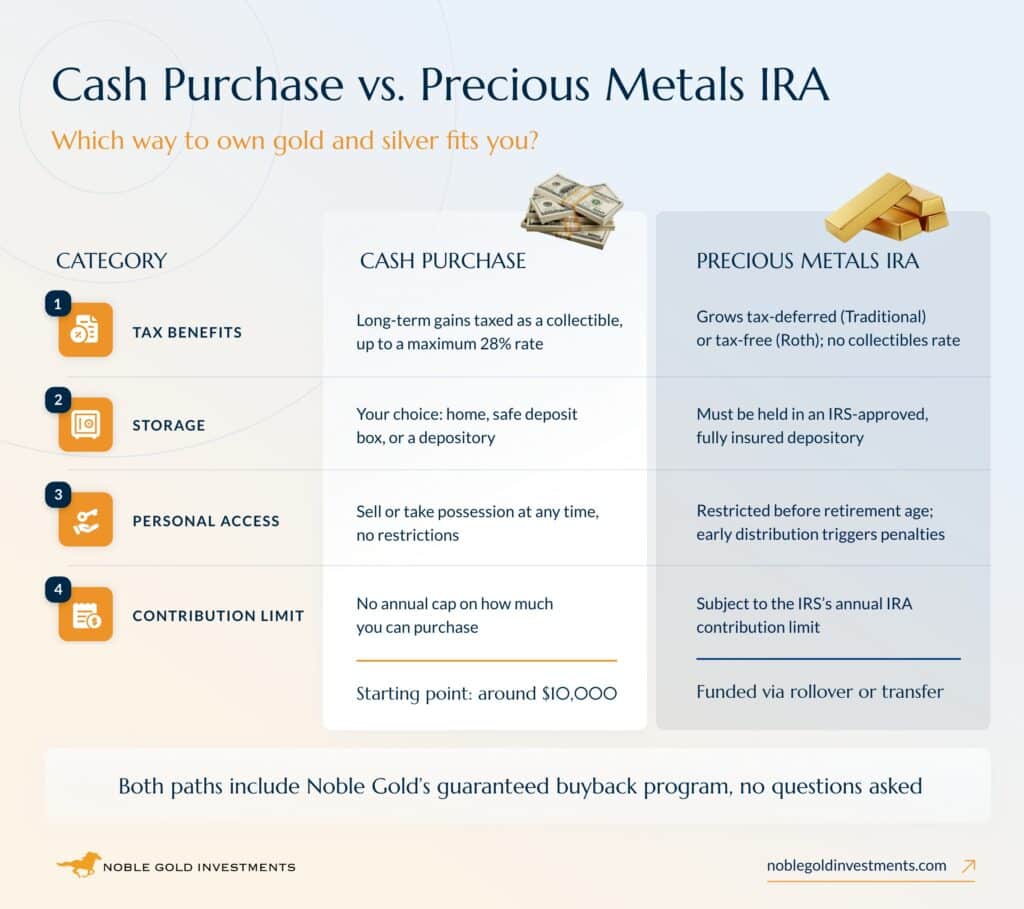
Cash Purchase vs. Precious Metals IRA at a Glance
| Factor | Cash Purchase | Precious Metals IRA |
| Minimum to get started | $10,000 | $20,000 |
| Funding source | After-tax cash on hand | Rollover or transfer from a 401(k), 403(b), TSP, SEP IRA, or traditional IRA |
| Account Structure | Taxed as any personal asset when you sell it | Grows tax-deferred (traditional) or tax-free (Roth) while held in the account |
| Annual contribution cap | None | Subject to the IRS’s annual IRA contribution limit; rollover amounts are not |
| Storage | Your choice: home, safe deposit box, or a depository | Must be held in an IRS-approved depository |
| Personal possession | Allowed at any time | Not allowed before retirement age without triggering taxes and penalties |
| Eligible products | Broader range, including collectible and numismatic coins | Must meet IRS purity standards for IRA-eligible metals |
| Ongoing fees | None with home delivery | Annual custodian and depository fees |
| Selling it later | Sell on your own schedule, including through a buyback program | Liquidate through the custodian; proceeds can be taken as cash or, at retirement age, as physical metal |
What’s the Difference Between a Cash Purchase and a Precious Metals IRA?
A cash purchase means buying physical gold or silver with after-tax dollars, and it’s yours immediately. You can store it at home, in a safe deposit box, or send it to a depository, and there is no restriction on when you sell or how you use the proceeds. With Noble Gold, a cash purchase starts at $10,000.
A precious metals IRA holds the same physical metal, but inside a tax-advantaged retirement account, with a $20,000 minimum to open. The metal must be IRA-eligible, meaning it meets specific IRS purity standards, and it must sit in an IRS-approved depository rather than your home. In exchange for those restrictions, the account carries the same tax benefits as any other IRA. The account itself is self-directed, which means you choose the specific coins or bars, while a custodian handles the paperwork and IRS reporting behind the scenes.
Where Can You Store Cash-Purchased vs. IRA Metals?
With a cash purchase, storage is entirely your choice. Many investors choose home delivery so they have direct physical access to their metal at all times, while others prefer the added security of a depository even though it isn’t required by law.
IRA metals don’t have that option. IRS rules require them to sit in an approved depository, such as Noble Gold’s own facility in Texas, and personal possession before retirement age can trigger taxes and a 10% early withdrawal penalty. Every metal Noble Gold ships to a depository is fully insured from the moment it leaves the dealer, so the added structure of an IRA doesn’t come at the cost of security. If direct access to your metal matters more to you than the tax deferral, that’s a real factor worth weighing before you decide.
Which Option Is Easier to Sell When You’re Ready?
Both paths are more liquid than many investors expect, but the process looks a little different for each.
With a cash purchase, you sell on your own timeline. Because the metal is already in your possession or held under your name at a depository, you can liquidate it whenever it makes sense for you. Noble Gold’s guaranteed buyback program applies here directly: if you purchased your metal from Noble Gold, the company will buy it back with no haggling and no added conditions, which removes much of the uncertainty investors associate with selling physical assets.
With an IRA, your custodian handles the sale, and the proceeds are distributed as cash or, once you reach retirement age, as physical metal. Our guide on how Gold IRAs work walks through what that liquidation process looks like in practice, including how a buyback program can speed it up. Either way, physical precious metals typically take a bit longer to convert to cash than stocks or ETFs traded on an exchange, so it’s worth planning a sale further in advance than you might with a brokerage account.
Can You Roll Over Retirement Funds Instead of Using Cash?
Yes, and this is often what makes the IRA route appealing in the first place. Investors don’t need spare cash sitting around to get started, they can move funds from an existing 401(k), 403(b), TSP, or SEP IRA, in addition to a traditional IRA. Our 401(k) to Gold IRA rollover guide and 401(k) to Silver IRA rollover guide walk through how a direct rollover avoids taxes and penalties, which isn’t something a cash purchase offers since it’s funded with money you’ve already paid income tax on.
Noble Gold’s account managers coordinate directly with your existing plan administrator and the new custodian to keep the transfer moving, so the rollover itself doesn’t require you to become an expert in IRS paperwork. That support is available regardless of which precious metals you ultimately choose, since gold, silver, platinum, and palladium can all be held in the same self-directed structure.
What Does It Take to Get Started With Either Option?
Minimums and costs are often the deciding factor for investors who are otherwise on the fence. A cash purchase starts at $10,000, and a one-time wire transfer fee of $30 is all you need. There’s no account setup fee since there’s no custodian or IRA structure involved, so your full investment goes toward the metal itself.
A precious metals IRA has a $20,000 minimum. IRAs carry their own account-opening and custodial structure, but the fee is flat regardless of how large the account grows:
| Gold & Silver IRA Fee | Amount |
| One-time Account Setup Fee | $50 |
| One-time Wire Transfer Fee | $30 |
| One-time In Kind Distribution Fee | $75 |
| One-Time Account Closure Fee | $250 |
| Annual Account Maintenance | $125 |
| Annual Metals Storage | $160 |
Because the fee doesn’t scale with your balance, it makes up a smaller share of your total cost as the account grows. You can see how that flat-fee structure works in more detail on our Gold IRA page. Whichever path you choose, you’ll know your fees upfront, and you’ll have access to the same guaranteed buyback program and insured depository storage when it’s time to sell or check on your holdings.
Which Option Actually Fits Your Situation?
There isn’t a universally correct answer, but a few questions tend to clarify it:
- Are you funding this with existing retirement savings or with cash on hand? Rollover funds point toward an IRA. Disposable savings work for either path.
- Do you want the option to physically hold or access your metal? A cash purchase with home delivery gives you that. IRA metals cannot legally be kept at home.
- Is tax-advantaged growth more valuable to you than flexibility? If that matters most to you, an IRA structure has a real advantage — our tax implications of a precious metals IRA guide covers the specifics. If you want to sell on your own timeline without touching a retirement account, cash ownership is simpler.
- How much are you investing? IRAs are subject to annual contribution limits; cash purchases are not, which matters for investors looking to allocate a larger sum at once.
- How soon might you need access to the funds? Distributions from an IRA before retirement age generally trigger taxes and a penalty, while cash-purchased metal has no such restriction.
It’s also worth understanding the IRA requirements and restrictions before committing either way, since eligibility rules apply to the metals, the custodian, and the account itself. And because self-directed IRAs allow for a wider range of assets than typical retirement accounts, it’s worth reviewing the joint investor alert on self-directed IRAs issued by the SEC, FINRA, and NASAA, which outlines the general due-diligence questions worth asking of any custodian regardless of who you work with.
Neither path guarantees a particular return, and both carry the same underlying market risk that comes with any physical commodity. Working with a specialist who can walk through your specific timeline and retirement goals is often the most efficient way to settle the decision.
Frequently Asked Questions
Can I buy the same gold and silver products with cash as I can in an IRA?
Not always. IRA metals must meet specific IRS purity standards to qualify, while a cash purchase can include a broader range of coins, bars, and collectible products that wouldn’t otherwise be IRA-eligible.
Is it possible to convert a cash purchase into an IRA later?
Generally, no. Metals you already own outright cannot simply be deposited into an IRA. IRA-held metals must be purchased directly through the account and shipped straight to an approved depository.
Which option has lower ongoing costs?
A cash purchase with home delivery has no ongoing custodian or storage fees. An IRA carries an $80 one-time setup fee and a flat $275 per year for custodial services and segregated storage, which is the cost of the tax advantages the account provides.
Can I lose money with either option?
Yes. Gold and silver prices fluctuate, and neither a cash purchase nor an IRA guarantees a gain. Precious metals also don’t generate income the way dividend stocks or bonds can, so their role in a portfolio is typically as a hedge and store of value rather than a source of yield.
What’s the minimum amount I need to get started?
A cash purchase with Noble Gold starts at $10,000. Opening a precious metals IRA requires a minimum of $20,000, regardless of which eligible retirement account you’re rolling over from.
Do I have to choose only one option?
No. Many investors do both, holding some metal in an IRA for tax-advantaged retirement savings and some purchased with cash for direct access and flexibility.
Ready to explore your options? Get started with a specialist, or download our free Gold and Silver Guide to compare both paths in more depth.